A new paid motion rarely fails because you picked the wrong channel. It fails because the learning loop never closed. The teams that get a new motion producing pipeline inside a quarter share one habit: they decide up front what a real conversion is and how fast they can act on what it tells them.
You are probably reading this because you are hiring for that seat right now. You have budget approved and a channel in mind. The real risk here is a full year of spend and activity that never produces a clean read on whether the motion works, long after a launch that went fine.
That outcome is common, and it is avoidable. What follows is how we think about it across the Google and LinkedIn accounts we run, and what we would do before you fill the role.
The short version
- Launching a channel and building the learning loop are two different projects. Only the second one makes the motion work, and most plans budget for the first.
- The most common reason a new motion stalls is a wrong optimization target. The platform optimizes to the cheapest counted action, so the dashboard looks healthy while pipeline stays flat.
- Bidding systems need volume to produce a stable read. Google recommends evaluating Smart Bidding over a window of at least 30 conversions in 30 days. Below that, performance swings are wide.
- Long B2B sales cycles mean a deal that closes in month four never feeds back as a signal unless you engineer it to.
- You compress the learning curve by fixing the signal and tightening cycle time, not by pouring budget into a loop that cannot use it.
Launching a channel is not the same as building the motion
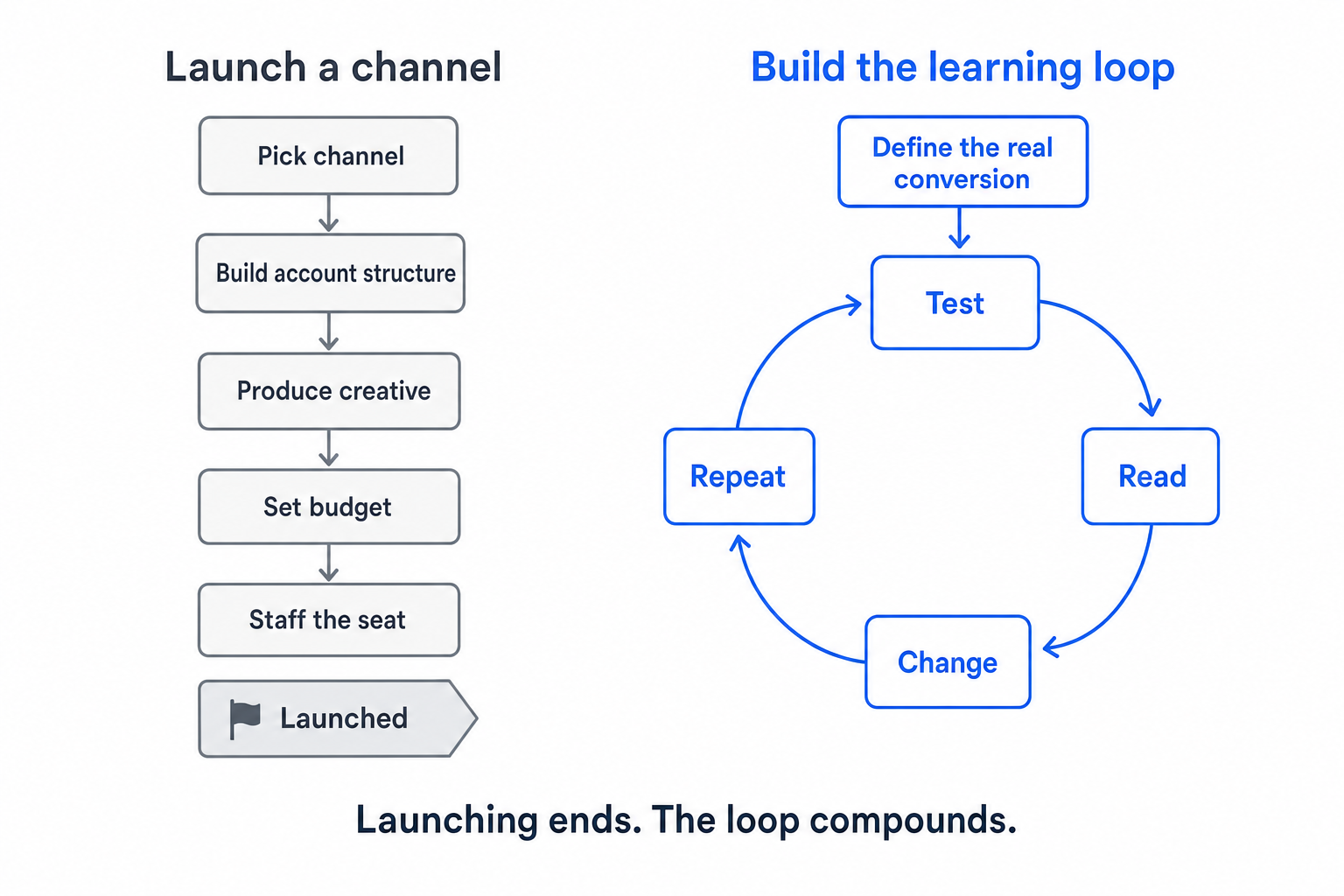
Launching a channel is a setup project. You build the account structure, produce creative, set a budget, and put a person in the seat. It has a clear finish line, and you can hit it in a few weeks. Most new-motion plans are scoped to exactly this and assume the rest forms on its own.
The motion is the loop that runs after launch: it reads results and changes the next move. That loop is the actual deliverable, and it is where new motions live or die. When a plan staffs the launch and treats the loop as an afterthought, the motion spends money on schedule and learns nothing on schedule.
Across the accounts we run, the initial build is rarely what separates a motion that works from one that stalls. Iteration cadence is. A campaign set up well and then left alone decays. The auction shifts, creative fatigues, the audience saturates, and the message that landed at launch goes stale, so a structure that looked strong quietly loses ground over the following weeks. The build is the price of entry. The loop is the work.
Why new motions stall: the feedback loop and the optimization target
New motions stall for two reasons, and they compound. The optimization target is pointed at the wrong action, and the loop that would catch it is too slow or missing. Fix one and leave the other, and you still lose the quarter.
Here is the most useful thing we can tell you, because it is the pattern we see most often when we open an account. The counted “conversion” is a soft action: a form-start, a content download, a page scroll, a pricing-page visit. The bidding system does exactly what you told it to and buys the cheapest version of that action. The dashboard fills with green. Cost per conversion looks great. Pipeline does not move, because none of those actions was a buyer.
Now pair that with volume. A bidding algorithm needs a meaningful count of the signal you are optimizing toward before it can produce a stable read. When the signal is a soft action, you get plenty of volume and a confident optimization toward the wrong thing. When the signal is a real buyer action, volume is thin, and the read is noisy. A motion fragmented across too many small campaigns, or pointed at the wrong signal, can burn a full quarter before anyone realizes the loop never closed.
The wrong optimization target
The trap is that a soft-conversion setup looks like success for weeks. Blended conversion definitions make it worse: when a form-start and a booked demo both count as “conversions,” the platform cannot tell them apart, so it optimizes toward whichever is cheaper and more plentiful. That is almost always the low-intent one.
Practitioners who work this problem in public say the same thing. Natalia Hernandez at Brainlabs has written plainly about the gap between optimizing to platform metrics and optimizing to pipeline, and why a channel can report strong numbers while contributing little to revenue. Bret Starr at The Starr Conspiracy makes a related point in his analysis of why B2B paid media struggles to become predictable pipeline: the metrics that are easy to optimize toward are often the ones furthest from a closed deal.
The missing feedback loop
The second failure mode is velocity. If reading results and changing the next move takes weeks, the loop turns too slowly to matter, and the volume problem gets sharper.
Google is explicit that Smart Bidding performance should be judged over a window, not a day. Its guidance on Smart Bidding and Target CPA recommends evaluating over at least 30 conversions in the trailing 30 days, and its Target ROAS guidance raises that to 50. It also recommends waiting roughly four weeks, or three conversion cycles, before you calibrate. The algorithm starts learning from day one. The point is that your read is unreliable until the window fills. Google's documentation for Display Smart Bidding says it directly: more conversion volume shortens the learning period and narrows the variance, and below about 30 conversions a month you should expect wider swings and learning that can take up to four weeks.
LinkedIn behaves differently, and it helps to be precise about it. LinkedIn does not publish a formal learning-period day count. What it does publish is delivery guidance driven by audience size and time. Its campaign setup and audience best practices set a 300-member hard floor, recommend at least 50,000 members for demand-gen prospecting, and advise running an ad set for a minimum of seven days before you judge it. Delivery stabilizes as the audience is large enough and the campaign has run long enough, and a thin audience produces exactly the noisy, expensive read you are trying to avoid.
The B2B problem: your best signal arrives too late
Everything above assumes the buyer signal arrives in time to teach the loop. In B2B, it usually does not. That is the structural problem underneath every new-motion launch, and it is why tactics borrowed from ecommerce quietly break.
The cycles are long and getting longer. Optifai's 2026 B2B SaaS sales cycle benchmarks, drawn from 939 companies across all ACV tiers, put the median cycle at 84 days, with mid-market deals between $15K and $100K ACV landing in the 30-to-90-day range. The Ebsta and Pavilion 2024 B2B Sales Benchmark Report, built on 4.2 million opportunities across 530 companies, found cycles running 38 percent longer than 2021 levels. The direction is clear: your best signal, a closed-won deal, arrives months after the click that started it.
A bidding algorithm reading the last 30 days cannot see a deal that closes in month four. Unless you engineer the feedback, that signal never reaches the platform, and the motion optimizes on the noisy early actions it can see. Bret Starr's analysis makes this concrete for anyone tempted to copy an ecommerce playbook: a 14-day test window fits a short purchase cycle, and it tells you almost nothing about a motion whose payoff lands a quarter later. The fix is to import offline conversions and to test leading indicators, so the loop has something honest to learn from before the deal closes.
There is a further consequence worth naming, because it changes how you should think about the whole exercise. With sparse conversion data and long feedback loops, the number of real optimization cycles you get in a year is small. In our experience running these accounts, most experiments do not win; something closer to two in ten produce a change worth keeping. When you only get a handful of clean reads a year and most tests are negative, a wrong target or a slow loop eats most of your year.
How to compress the learning curve
You cannot make a B2B sales cycle shorter. You can make the loop around it turn faster and read cleaner. Four moves do most of the work, and they build on each other.
- Define the real conversion first. Optimize toward buyer-signal actions such as a booked demo or a qualified opportunity, and keep engagement events like content downloads as observe-only. This is the single decision that determines whether the platform learns anything useful, so make it before you spend a dollar.
- Concentrate volume so the system can learn. Consolidate rather than fragment across a dozen tiny campaigns, so the signal you care about reaches enough monthly volume to produce a stable read instead of noise.
- Engineer the feedback the platform cannot see. Import offline conversions from the CRM, and instrument leading indicators such as engaged-account rate and SQL rate, so the month-four outcome is not lost and you have honest early proxies to act on.
- Shorten cycle time. Build a tight loop of test, read, change, and repeat, and remove the handoffs between the person watching the data and the person making the change. Budget only converts into learning as fast as you can act on it.
The through-line ties back to who you hire. The learning loop is the deliverable. The person in that seat should be measured on how fast the loop closes, not how fast the campaigns launched.
What is normal, and what will slow you down
A few things are worth expecting so you do not misread them as failure. Most experiments will not work, and that is the job, not a warning sign. Early weeks are volatile by design, because the read is unreliable until the evaluation window fills, so a flat two-week stretch is not automatically a dead motion. And a channel that works for another company is not guaranteed to work for yours; the honest version of this work includes being willing to conclude a channel is wrong.
What actually slows you down is more specific: a budget too thin to reach the volume the algorithm needs, a motion fragmented across campaigns so no single one gets there, a conversion signal you never fixed, and handoffs that stretch every read into weeks. All of those are within your control, and they cause more stalled quarters than any channel choice.
Frequently asked questions
How long before a new paid motion shows real results?
Plan on a quarter before you trust the read, not a month. Google recommends evaluating Smart Bidding over at least 30 conversions in 30 days, and B2B sales cycles now run around 84 days at the median per Optifai's 2026 data. Early numbers are directional, not conclusive.
Should I launch on Google or LinkedIn first for a new motion?
It depends on intent and audience, not on which platform is better. Google captures existing demand, so it suits motions where buyers already search. LinkedIn targets by firmographic fit, which suits prospecting into a defined account list. We run both, and the sequencing follows where your buyer signal is strongest.
How much budget do I need to stand up a new paid channel?
Enough to reach the volume the algorithm needs on your real conversion, sustained long enough to fill the evaluation window. A budget too thin to hit roughly 30 monthly buyer-signal conversions will produce wide swings and slow learning, per Google's own guidance, no matter how carefully you set it up.
What conversion should I optimize a new motion toward?
A buyer-signal action, such as a booked demo or a qualified opportunity, not a form-start or a download. Keep the soft actions as observe-only metrics. The platform buys whatever you count, so counting low-intent actions teaches it to find more low-intent actions cheaply.
Should I hire in-house or use an agency to stand up a new motion?
Either can work if one accountable owner runs the loop end to end and iterates fast. It breaks when ownership is split across a strategist, an in-platform operator, an analyst, and an approver, because every handoff slows the read-and-change cadence that a new motion depends on.
How do I know if the motion is failing or just still learning?
Check the loop, not the mood. If your evaluation window has filled with real buyer-signal conversions and pipeline is still flat, that is a signal. If you are still inside the first few weeks on thin volume, you do not have a read yet. Volatility early is expected.
The easy half is the launch
A new paid motion succeeds on whether the learning loop closes and reads the right signal. Launching the channel is the easy half, and it is the half most plans overstaff. Before you fill the seat, decide two things: what a real conversion is for this motion, and how you will get that signal back into the platform fast enough to act on it. Get those right and the channel choice mostly takes care of itself.
This is the work we do. Thunder runs paid media on Google and LinkedIn end to end, with one accountable operator who is AI-enabled and embedded in your account, so the loop closes in hours instead of weeks and every account compounds what it learns. We helped build the LinkedIn Ads platform, and we run paid media for teams including Reddit, Gusto, Warp, and Linear. If you are standing up a new motion and want a second read on the plan before you hire for it, start a conversation with us.