When a funded paid program stops growing, the growth lever is almost never more budget. It is one binding constraint holding the whole system back, and until you find it, every extra dollar buys more of the same result.
Across the accounts we run on Google and LinkedIn, that plateau usually traces to a single stage in the path from click to revenue. The usual culprits are a conversion signal that counts the wrong action, a landing page that drops the ad's promise, a targeting leak, or an offer that does not land. It rarely traces to the bid settings everyone reaches for first.
You know the situation. Spend is meaningful. The dashboard is busy with clicks and conversions. Results are flat, and the instinct in the next planning meeting is to ask for more budget. Here is what is at stake: double the spend against the same constraint and you get the same outcome at twice the cost.
Summary
- A plateaued paid program has a binding constraint. More budget against it buys the same result at a higher cost.
- Most "optimization" is platform tuning (bids, keywords, pacing) when the real limit sits in creative, the landing page, conversion tracking, targeting, or the offer.
- The fastest way to diagnose it is to follow the money from click to closed-won and find where qualified pipeline actually breaks.
- Bid algorithms cannot save an account fed the wrong signal or too few conversions to learn from.
- Performance comes from iteration velocity, not budget size. Take more quality shots, read each one faster, act on the constraint you find.
Why more budget stops working
The reflex is simple. The program plateaus, so someone asks for more spend. It fails because budget scales whatever is already happening, and that includes the constraint. You do not buy your way past a bottleneck. You feed it more volume.
Think about budget and cycle time as two separate dials. Budget sets how fast data arrives. Cycle time sets how fast you act on it. A bigger budget compounds a fast loop, because more data meets a team that can read and respond to it quickly. Pour that same budget into a slow loop and most of it is wasted, because the account learns faster than anyone acts.
Rising costs make the reflex worse. In Dreamdata's B2B Google Search Ads benchmark (September 2025, covering non-branded search across Dreamdata's B2B customer base), non-branded CPCs rose about 29% while click-through rate fell about 26% over August 2024 to July 2025. On the other side, HockeyStack's 2025 LinkedIn Ads benchmark, drawn from more than 70 B2B SaaS companies, puts LinkedIn CPCs in a seasonal band of roughly $10.48 to $15.72. Paying more per click into an unfixed constraint is the most expensive version of "more budget."
There is also a plain arithmetic problem. Gartner's 2025 CMO Spend Survey found marketing budgets flat at 7.7% of company revenue, with 59% of CMOs saying their budget is insufficient to execute their strategy (as reported by Marketing Brew). Ewan McIntyre, VP Analyst at Gartner, frames this as marketers being asked to do more with a budget that has stopped growing (the survey skews toward large enterprises).
So "just spend more" is not even on the table for most leaders. Efficiency is the lever that is actually available. If budget is not the answer, you need to know what is.
The distinction that matters: optimizing the platform vs finding the constraint
Most teams equate "optimizing paid" with "tuning the ad platform." Adjust bids. Change match types. Add keywords. Rework budget pacing. That work is real, and it is also just optimizing the platform.
The actual job is different. Find the binding constraint on the whole system and fix that. A creative problem, a landing-page problem, a tracking problem, and a targeting problem all look identical on the dashboard: ads underperforming. They need opposite fixes. Telling them apart is the skill.
Here is why platform tuning plateaus. You can only optimize the platform down to the quality of what you feed it. If the landing page does not continue the promise the ad made, no bid strategy rescues the conversion rate. You are asking the auction to fix a problem that lives after the click.
This is the core of it. You cannot fix paid channel by channel, because the real constraint is often the landing page, the tracking, or the offer, and none of those live inside the ad platform. Owning the whole system, from creative through attribution, is what lets you tell one problem from another instead of guessing.
Where the constraint usually hides
Walk the path the money actually takes. A click becomes a landing-page visit, becomes a tracked conversion, becomes qualified pipeline, becomes closed-won revenue. The plateau is one narrow stage on that path, not the whole funnel at once.
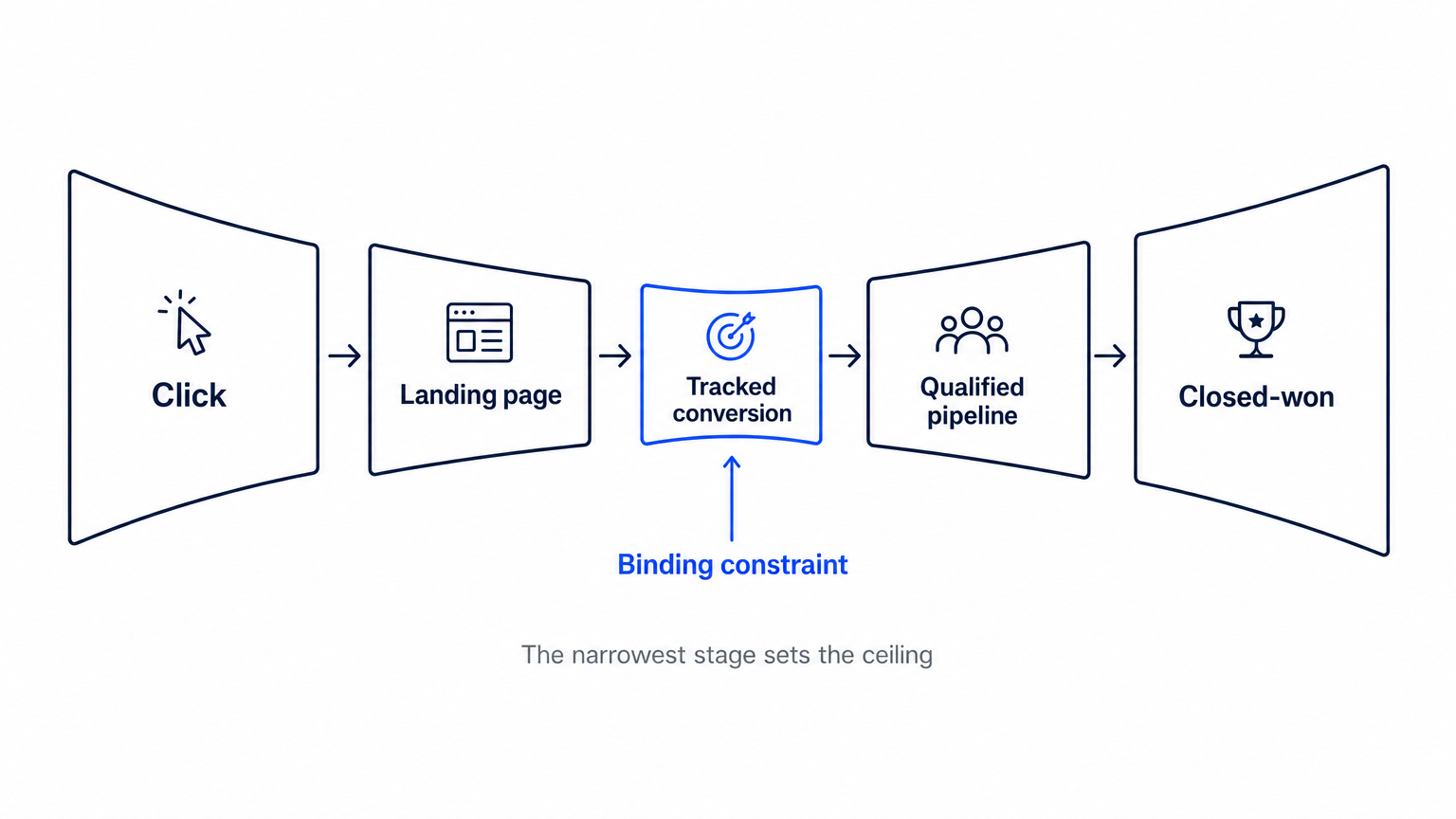
Find the narrowest stage and you have found the thing capping the program. Here is where it tends to hide.
The conversion signal (most common, least examined)
Start with what you count as a conversion. Often the counted action is a page scroll, a form-start, a content download, or a pricing-page visit, not a booked demo or a real opportunity. The platform does exactly what you told it to and buys the cheapest version of that action. The dashboard looks healthy. Pipeline does not move.
Bidding depends entirely on this signal. Google's own Smart Bidding documentation recommends at least 30 conversions in 30 days, and 50 for Target ROAS, before you judge performance. Below that, the algorithm lacks the signal to optimize well. Feed it the wrong 30 conversions and it will optimize toward the wrong outcome, efficiently. A related failure is fragmentation: demand split across so many campaigns that none of them reaches the learning threshold at all.
The landing page and the offer
The relevance chain has to hold: the search term, the ad copy, and the landing page all say the same thing. When that chain breaks, Quality Scores fall and conversion weakens, and the break is usually on the page rather than in the bid.
The spread here is large. In Unbounce's Conversion Benchmark Report, built from more than 41,000 landing pages, SaaS pages at the 75th percentile convert around 11.6% against a median near 3.8%, roughly a threefold gap. Unbounce's "SaaS" category mixes consumer SaaS and non-paid traffic, so treat the exact figures loosely. The point is the spread: the median page leaves a lot of qualified pipeline unconverted, and closing that gap does not cost a dollar of media.
Creative and targeting
Creative is a heavy lever, with an honest caveat. NCSolutions' "Five Keys to Advertising Effectiveness" analysis of around 450 campaigns attributes about 49% of sales lift to creative, the largest single driver (reported by Marketing Charts). A Nielsen and Google study on executional ROI drivers found ads that followed creative-quality principles saw 30% higher sales lift. Both datasets are CPG and consumer advertising, not B2B paid, so read them as a directional principle rather than a B2B benchmark.
Targeting leaks the other way. Broad and phrase match pull low-fit searches: free-template hunters, competitor lookups, unrelated job categories, and general research queries with no buying intent. Budget drains on inventory that never had a real buyer behind it, and the platform reports it as activity.
How to find your constraint
The method is a trace, not a guess. Follow one week of spend from click to closed-won and mark the stage where qualified pipeline actually breaks. Fix that stage first. Do not touch bids until the signal underneath them is right.
Be candid about what is normal, because this is where teams lose their nerve. Most experiments do not work. About two in ten move the needle, and you cannot know which two in advance. A/B testing programs confirm the shape: ConversionTeam reports a 19.1% win rate across 2,288 audited tests, and Optimizely, cited in the same analysis, reports roughly 12% across about 127,000 experiments. These are general CRO tests, directional for paid rather than exact.
So the tradeoff is real. Chasing the constraint means running more tests, watching most of them fail, and reading each result fast enough to act. That feels less tidy than a calm monthly bid review. It also works better, because volume of quality shots is what surfaces the fix.
One more reframe. A flat period is information. A plateau usually means the last constraint is now fixed and the next one has not been found yet. It rarely means the channel is tapped out.
What AI changes here
For years the slow parts of chasing constraints were the expensive parts. Researching the problem. Building a new landing page. Producing new creative. Reworking platform setup. Each of those took a handoff and a week, so a single iteration could run a month. That is the part AI collapses. The research, the page, the creative, and the platform ops now close in hours, which means the loop that used to take weeks runs same-day.
Here is what we see that a generic article will not tell you. Across the accounts we run on Google and LinkedIn, when a program has plateaued, the first fix that moves pipeline is rarely inside the ad platform. It is almost always upstream, in the conversion signal or the landing page. Once that one constraint clears, the same budget starts producing qualified pipeline it was not producing the week before. The teams that win are the ones who found the constraint and could rebuild the page or the tracking the same day, not the ones who found a clever bid.
Judgment stays with people. Deciding what is worth testing, and reading what a result actually means, is the part that matters, and it is not automated. Smaller and faster beats bigger and slower.
Frequently asked questions
Should I pause paid if it has plateaued?
No. A plateau is a diagnosis problem, not proof the channel is dead. Follow the money from click to closed-won, find the stage that breaks, and fix it. Pausing throws away the data you need to find the constraint in the first place.
How do I know if it is a creative problem or a landing-page problem?
Look at where people drop. Weak click-through with strong landing-page conversion points at creative or targeting. Strong clicks with weak conversion points at the page or the offer. Same dashboard symptom, opposite fixes, so read the drop-off before you act.
Isn't fixing conversion tracking an engineering project?
Partly, but the highest-value fix is usually definitional. Count booked demos and opportunities as conversions rather than downloads or form-starts. Get the signal right before you rebuild the plumbing, because the plumbing will optimize toward whatever you tell it to count.
Will smart bidding fix this for me?
No. Automated bidding optimizes toward the signal you give it. Google recommends at least 30 conversions a month, and 50 for Target ROAS, before you judge it. Feed it the wrong conversion and it will buy the wrong thing efficiently, every time.
How many tests should I expect to fail?
Most of them. Even strong teams see about two in ten experiments move the needle, and large testing programs report roughly one significant winner in five. The lever is running more quality tests and reading each one faster, not guessing the winners up front.
Does more budget ever help?
Yes, once the constraint is fixed. Budget sets how fast you learn, so a bigger budget compounds a fast loop and is wasted on a slow one. Fix the binding constraint first, then scale spend into a system that already converts.
Getting more out of paid is a diagnosis skill
Getting more out of paid comes down to diagnosis. Find the one stage where qualified pipeline breaks, fix it, then let budget scale a system that works. Your next move is concrete: run the click-to-closed-won trace on your own account this week and mark the narrowest stage.
Thunder is the operating layer for exactly this work. We run paid media end to end on Google and LinkedIn with one accountable operator, AI-enabled and embedded, so finding a constraint and fixing it (a new landing page, a corrected conversion signal, fresh creative, or a repaired relevance chain) happens the same day instead of across three handoffs. The team helped build the LinkedIn Ads platform and has run paid media for Reddit, Gusto, Warp, and Linear.
See how Thunder runs paid media end to end.